
Recap: Connect BC — Learning to Measure the Change We're Working Towards
By Liz Blakeway, Executive Director
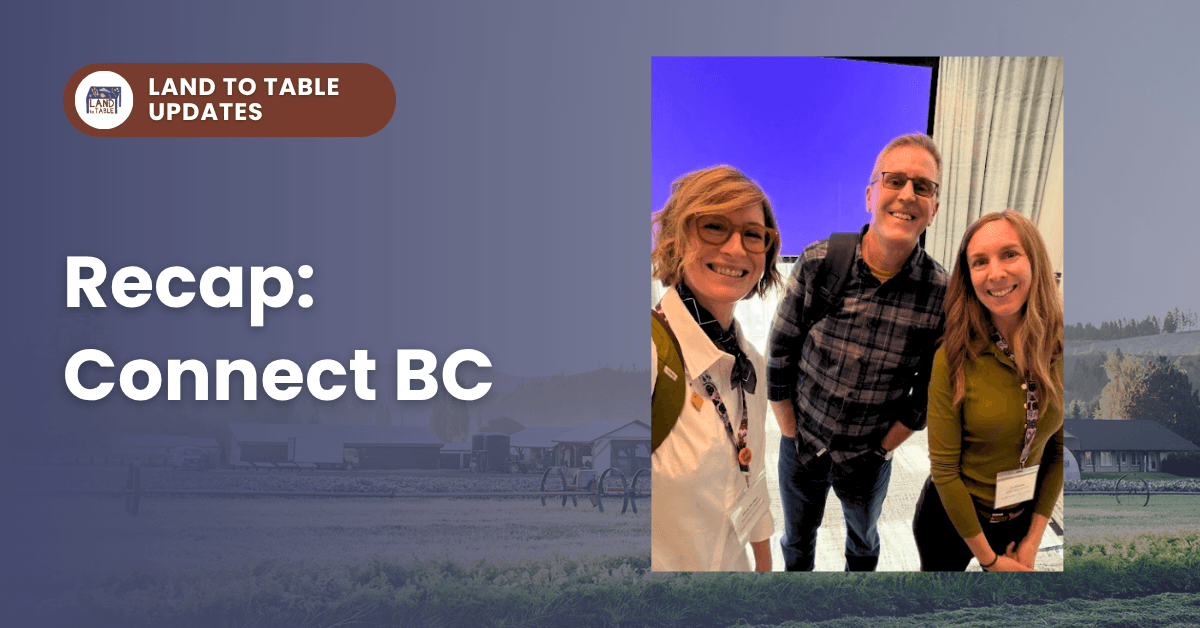
On September 17th, I had the opportunity to represent Land to Table at the Connect BC Conference in Kelowna, a gathering of community foundations from across BC and the Yukon. I joined Hilary Henegar of Abundance Collective (formerly Purppl) and Kevin Ronaghan of the Community Foundation of the South Okanagan Similkameen to share L2T’s experience with the Okanagan Prosperity Fund Impact Measurement Learning Program — and what we’ve learned about the value of investing in organizational capacity.
This opportunity grew directly out of the Okanagan Prosperity Fund grant L2T received through the North Okanagan Community Foundation. In addition to providing grants, the three Okanagan community foundations decided to try something different: they pooled resources to offer impact measurement learning to funded organizations across the region. Six organizations, including L2T, were also selected for deeper, walk-alongside coaching.
For us, the timing couldn’t have been better. Because our work spans the food system, we find ourselves making connections across food access, local food production, procurement, infrastructure development, climate resilience and regional collaboration. We understood how these pieces connected and the broader changes we were working toward, but much of the data we collected was tied to individual projects and funder requirements. We needed a way to move beyond measuring what we were doing to better understand and communicate what was changing as a result. And, with The Food Shed about to become operational, we had an opportunity to be clear about the impact we wanted it to have — and to make sure we were collecting the right data from the beginning.
Through the workshops, peer learning and one-on-one coaching, we developed a Theory of Change for Land to Table, starting with the impact we ultimately want to have and working backwards to understand how our work contributes to getting there. This was followed by a Theory of Change and Impact Measurement Framework for The Food Shed.
What I particularly value is that these haven’t become documents sitting on a shelf. Our organizational Theory of Change directly informed our new strategic plan and helped build shared understanding and ownership among our board and staff. Now, our Impact Measurement Framework is being integrated into our CRM, partner and producer engagement, work planning and funder reporting. As we shared at Connect BC, the progression has been: Theory of Change → Strategic Planning → Board & Staff Buy-In → Measurement → Program Integration.
And we’re still building it. Our initial scan identified more than 250 potential indicators that could help tell the story of change in our regional food system. Our Food Security Manager, Sammy Blair, is now leading the work of narrowing those down by asking: What is actually important for us to know? Why? Is Land to Table the right organization to collect it? And where will that information live?
Ultimately, we’re working toward something much bigger than better grant reporting. We want to connect what we’re learning through The Food Shed, our partners, producers and regional network with broader measures of food security and food-system resilience — building a clearer picture of how our collective work, including the new infrastructure of The Food Shed, is contributing to a thriving regional food system.
One of the things I wanted community foundations to hear from our experience is that this kind of capacity building works — but it takes time. The coaching and peer learning gave us the accountability and structure to make this work a priority, but it also takes dedicated staff capacity to carry it forward. Having Sammy develop the skills to hold and implement this work internally means we’re able to build impact measurement into how L2T operates, rather than treating it as something we do when a funder report is due.
I’m grateful to the North Okanagan Community Foundation, and to the three Okanagan community foundations collectively, for investing not only in the work we’re doing, but in our capacity to better understand, learn from and communicate its impact.