
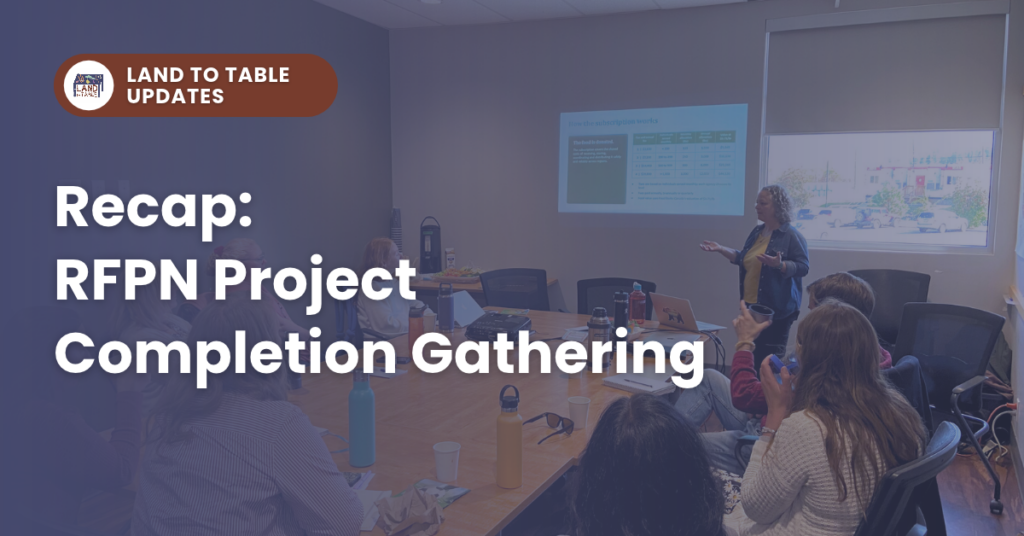
Two Years of Working Together: Recapping the RFPN Project Completion Gathering
On October 8, 2026, we gathered at the Splatsin Centre in Enderby, on the traditional, ancestral, and unceded territory of the Splastin First Nation, the southernmost community of the Secwépemc Nation, to mark the end of the Regional Food Procurement Network (RFPN) project. Food bank staff from Golden, Revelstoke, Sicamous and Cranbrook joined the Land to Table and Food Shed team for a day of looking back, touring the new warehouse, and planning what comes next.
Looking back on two years
Melissa Hemphill, RFPN Coordinator, opened the day by walking everyone through how we got here. The project grew out of a 2023 study of four rural food banks, which found that they serve a far larger share of their town populations than food banks in Vancouver or Calgary. At the same time, BC food bank visits have risen 81% since 2019 and food prices 36%. Golden had lost its primary recovered food source of more than a decade, Sicamous had lost a key recovery channel, and food banks were buying more food than ever to keep up.
The original plan was a shared regional warehouse. When that funding wasn’t approved, the project adapted, shifting toward research, pricing, recovery partnerships and cost recovery support. That pivot led to The Food Shed in Armstrong, and the RFPN helped shape its supply agreements, ordering platform and business plan.
Here is what the network accomplished between December 2024 and September 2026:
- 100,995 lbs of recovered food, valued at $363,817, moved across 103 pallets
- $52,207 in coordinated purchasing, including regular non-perishable orders and local meat, eggs and produce from Golden farmers
- 16,216 lbs shared onward (valued at $60,161) to 12 organizations beyond the founding food banks, including schools, seniors’ housing, churches and other food programs
- Three cost recovery programs launched: Meal Kits in Golden, and Good Food Boxes in Revelstoke and Sicamous
The numbers also showed what couldn’t be done. Without shared storage, 36,443 lbs of food worth $130,372 was declined or lost. That is the gap The Food Shed was built to fill.
What the group reflected on
The conversation around the table was just as valuable as the data. Several themes came up again and again.
Connection is the point. Participants described the isolation of day-to-day food bank work and the relief of having a community of people fighting the same battles. As one participant put it, “You don’t have to do it alone, and this is the solution.” Others talked about sharing ideals, learning from each other’s mistakes, and easing the administrative burden together.
The project made new things possible. One food bank shared that a year ago they would have said no to the Good Food Box program due to staffing shortages. The push from the project, plus a designed, working model, changed that. Others pointed to the work of connecting recovered food across regions.
Capacity is the challenge. Staffing and volunteer shortages came up repeatedly, from a generational shift in who has time to volunteer to seniors who can’t afford to retire. As Melissa said, there’s no such thing as free food: someone has to be paid to make it happen, and that’s just one piece of the puzzle. Staffing, transportation, storage, coordination, and shipments are all a cost of food.
Meeting the Food Shed team and touring the warehouse
We introduced the team behind The Food Shed: Liz Blakeway, Stephanie Sundquist, Jessie Wootton, Sammy Blair, and Janine de la Salle. Stephanie manages day-to-day operations, including price lists, orders, logistics and billing, while Melissa joins The Food Shed to continue the work of supporting food banks, coordinating recovered and volume-purchased food, and convening with community organizations.
After lunch, everyone headed to the warehouse in Armstrong, where The Food Shed shares space with Valley Direct Foods. Seeing the regional distribution centre in person made real what had been a plan on paper for two years.
How the Food Recovery Access Subscription will work
The afternoon focused on the next phase. This fall, four food banks are moving into the Food Recovery Access Subscription, a shared model for getting recovered and purchased food to the communities that need it.
The food itself is donated. The subscription helps cover the shared costs of receiving, storing, coordinating and distributing it safely and reliably across the region. In return, food banks get dependable access to recovered food, affordable shared purchasing, online ordering and inventory tools, and a regional network for learning and collaboration.
We walked through the draft service agreement and the new ordering platform, and asked the group what The Food Shed should stock. We were also upfront that 2026-27 is a demonstration year, and we expect to adjust as we learn. Participants raised good questions about timelines, fundraising and delivery, and we’ll keep working through them together.
What’s next
Melissa reminded everyone of the thinking behind the work: “People experiencing food insecurity in small rural communities deserve the same reliable access to nutritious food as those living in larger urban centres.”
Here is what’s coming up:
- October 2026: subscriptions begin
- Late November: The Food Shed launch week (November 22 to 29), with a virtual launch event on November 24
- Early December: our first quarterly subscriber check-in, online
- Spring 2027: an in-person gathering
Our new website, thefoodshed.ca, will be finished in early November, and we’ll be sharing updates through email newsletters and social media.
Thank you to everyone who joined us in Enderby, and to the food banks and partners who made these two years possible. Two years of working together has given us a regional system to build on, and we’re glad to be doing it with you.
Questions? Reach us at foodaccess@thefoodshed.ca.